
SIAS Score: Understanding Your Social Interaction Anxiety Scale Results
If you just took the Social Interaction Anxiety Scale and you are looking at a score that feels both clinical and personal, you are in the right place. Social anxiety has a way of being invisible to everyone except the person living with it. The conversation you replayed in your head for three days, the meeting you spent more energy preparing for than attending, the moments where everyone else seemed to know what to say while you froze – those experiences are real, and they deserve language and structure to make sense of them.
That is where the SIAS comes in. Your SIAS score is not a label or a verdict. It is a structured way of capturing how much social anxiety is shaping your daily interactions so that you and a provider can have a more informed conversation about what to do next. This article walks you through what the SIAS measures, how scoring works, what each range means, and when reaching out for clinical support makes the most sense.
What Is the Social Interaction Anxiety Scale?
The Social Interaction Anxiety Scale, commonly abbreviated as the SIAS, is a 20-item self-report questionnaire developed by Richard Mattick and J. Clarke in 1998 at the University of New South Wales. It was designed to measure the anxiety people experience during direct social interactions – things like meeting new people, mixing in a group, talking with authority figures, and sustaining everyday conversation. The SIAS takes 5 to 7 minutes to complete and has been used in clinical and research settings worldwide for over two decades.
What makes the SIAS distinct is that it was developed alongside the Social Phobia Scale (SPS) as a companion pair. The SIAS captures anxiety during social interaction, while the SPS captures anxiety from being observed or scrutinized. Together they offer a more complete picture of social anxiety than either tool would alone. You can take the interactive SIAS quiz here on this site if you have not already, or use this page to interpret a score you already received. For the original psychometric validation, you can review the Mattick and Clarke 1998 paper on PubMed.

What the SIAS Actually Measures
The SIAS asks about the feelings, thoughts, and behaviors that arise when you are directly engaging with other people. The 20 questions cover a range of social interaction situations, sampling these key areas:
- Comfort with strangers: tension and anxiety when meeting or talking with people you do not know well
- Mixing in groups: difficulty entering, joining, or sustaining group conversation
- Self-consciousness: the experience of feeling exposed or evaluated during ordinary exchanges
- Eye contact and physical presence: discomfort with direct social signaling, including making and holding eye contact
- Talking to authority figures: anxiety in conversations with bosses, teachers, providers, or anyone you perceive as having power
- Worry about saying the wrong thing: pre-conversation rumination and post-event review that drains energy long before and after social encounters
How SIAS Scoring Works
Each of the 20 items on the Social Interaction Anxiety Scale is rated on a 5-point Likert scale, with response options ranging from 0 (Not at all characteristic or true of me) to 4 (Extremely characteristic or true of me). You select the rating that best describes how true each statement is for you in your typical experience. The original Mattick and Clarke version includes 3 reverse-scored items – these are positively worded statements where a high comfort response actually corresponds to a low anxiety score. Most online and clinical software versions of the SIAS handle the reverse scoring automatically, so you do not need to do the math yourself.
Your total SIAS score is the sum of all 20 item responses, with reverse scoring applied where appropriate. The total ranges from 0 to 80, with higher scores indicating greater social interaction anxiety. The score is best interpreted in context: a score of 30 in someone who handles their job and personal life comfortably means something different than the same score in someone whose career and relationships are constrained by avoidance.
SIAS Score Interpretation
The following table summarizes the standard SIAS interpretation thresholds derived from the research literature, including the widely cited cutoff values used in clinical practice:
What Each SIAS Score Range Means
Score 0 – 19: Minimal Social Anxiety
A score in this range suggests that social interaction anxiety is not a clinical concern at this time. You may still feel nervous before certain situations – that is completely normal and healthy – but social anxiety is not significantly limiting your daily life. Maintaining healthy social engagement and reasonable self-care is the most useful step at this level.
Score 20 – 33: Mild Social Anxiety
Scores in this range reflect some social interaction anxiety that is real and noticeable but not yet at a clinical level. You might find yourself avoiding certain situations, replaying conversations afterward, or feeling drained after social engagements. This range warrants attention: lifestyle strategies, social skills practice, and an honest conversation with a provider can prevent symptoms from escalating, especially if avoidance behaviors are starting to shape your choices.
Score 34 – 42: Probable Social Anxiety Disorder (Situational)
An SIAS score 34 to 42 falls in the range that researchers have associated with situational social anxiety disorder – anxiety that meets clinical thresholds but is largely tied to specific contexts, such as public speaking, work meetings, or dating. At this level, a full psychiatric evaluation is strongly recommended. Cognitive behavioral therapy with exposure work is highly effective, and your provider can also discuss medication options that have strong evidence for social anxiety disorder.
Score 43 – 80: Generalized Social Anxiety
An SIAS score 43 or higher reflects generalized social anxiety – anxiety that spans many situations and substantially shapes daily life, work, and relationships. Active, structured treatment is strongly indicated at this level, and the impact on quality of life is often significant. The National Institute of Mental Health offers detailed information on evidence-based treatments for social anxiety disorder, and connecting with a psychiatric provider quickly is the recommended path forward.
SIAS vs SPS: The Two Sides of Social Anxiety
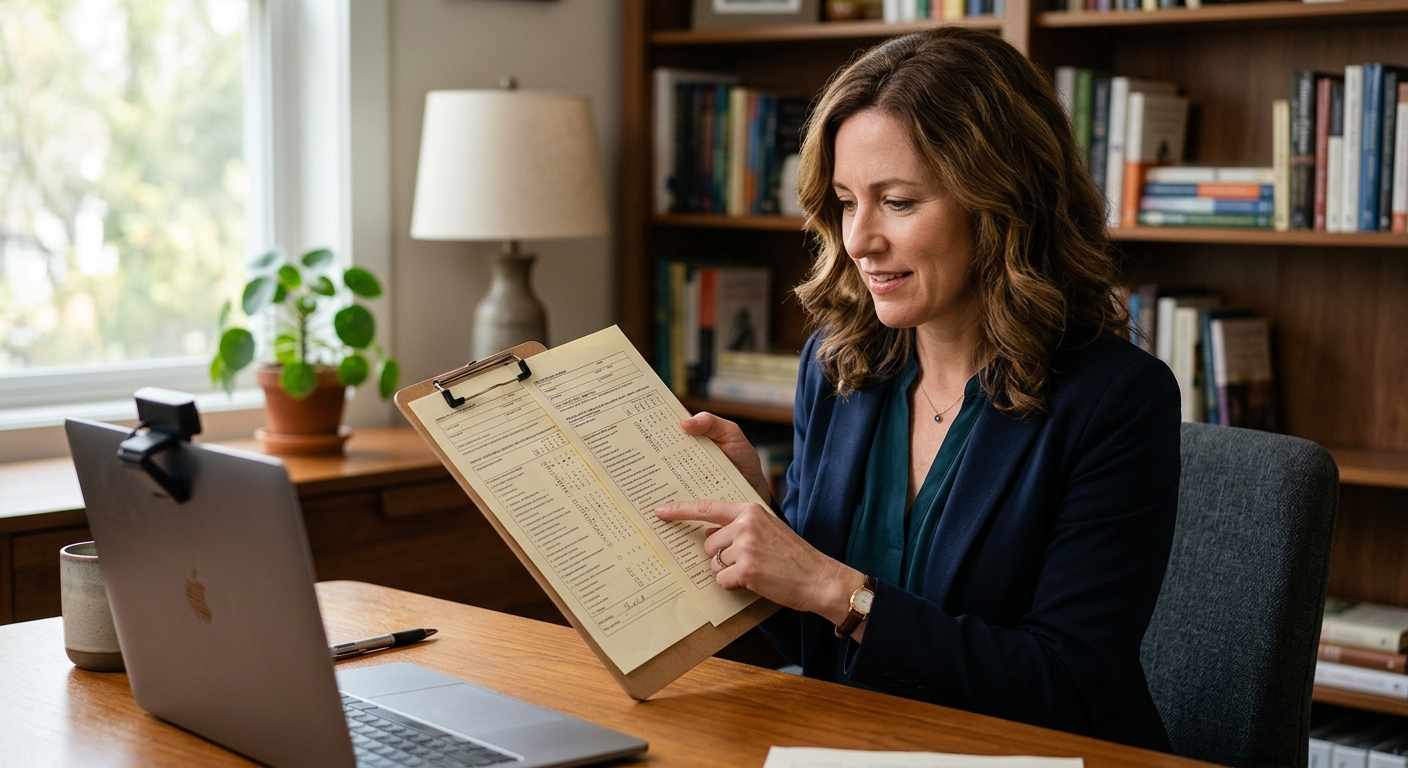
Mattick and Clarke designed the SIAS and SPS as a complementary pair, and understanding the difference can sharpen what your scores actually mean. The SIAS measures anxiety during social interaction – situations where you are talking, mixing, meeting, or actively engaging with someone else. The SPS, or Social Phobia Scale, measures anxiety from being observed, watched, or scrutinized – situations like eating in public, signing your name while someone watches, or performing in front of an audience.
Many people with social anxiety disorder score high on both, but some show a clear pattern on just one. Someone whose anxiety is mostly about meeting new people and sustaining conversation may have a high SIAS but a more moderate SPS. Someone whose anxiety is mostly about being observed and performing may have the reverse. A complete clinical picture often uses both measures, which is why your provider may recommend completing the SPS in addition to the SIAS.
How Social Anxiety Connects to Other Mental Health Conditions
Social anxiety rarely shows up in isolation. Research has consistently demonstrated high rates of co-occurrence with major depressive disorder, generalized anxiety disorder, panic disorder, and substance use disorders. The avoidance behaviors that social anxiety drives – declining invitations, skipping classes, taking on lower-profile work – can over time amplify low mood, isolation, and worry. Treating social anxiety often leads to meaningful improvement in these co-occurring conditions as well.
If you are also experiencing low mood, persistent worry, or trauma-related symptoms, reviewing your PHQ-9 depression score, your GAD-7 anxiety score, or learning more about agoraphobia and avoidance-based anxiety can give your provider a fuller picture of what is happening. Using multiple validated tools together is standard clinical practice for good reason.
How Accurate Is the SIAS?
The SIAS has been studied extensively and consistently demonstrates strong psychometric properties. Mattick and Clarke (1998) reported high internal consistency, with Cronbach’s alpha typically falling between 0.88 and 0.94 across populations. Test-retest reliability is also strong, and the SIAS shows good convergent validity with other established measures of social anxiety. Brown and colleagues (1997) demonstrated that the scale reliably discriminates between people with clinical social anxiety disorder and community controls, supporting its use as a screening tool in both research and clinical settings.
That said, the SIAS is a screening instrument, not a diagnostic tool. A formal diagnosis of social anxiety disorder requires a comprehensive clinical interview that considers symptom duration (typically at least 6 months), distress, and functional impairment. Your SIAS score is a meaningful starting point – it opens the conversation rather than closing it.
Using the SIAS to Track Treatment Progress
One of the most valuable applications of the Social Interaction Anxiety Scale is repeated administration during treatment. Because the SIAS is brief and the scoring is standardized, your provider can use it at regular intervals to measure whether your symptoms are improving. The SIAS has been shown to be sensitive to clinical change, particularly with cognitive behavioral therapy that includes exposure work.
A practical example: if your baseline SIAS score is 50 and it drops to 30 after 12 weeks of CBT, that 20-point reduction reflects meaningful, measurable progress – not just random fluctuation. Tracking this trajectory helps you and your clinician make informed decisions about continuing, adjusting, or stepping down treatment. SSRIs and SNRIs are also evidence-based pharmacological options that are often added when CBT alone is not sufficient.
Limitations of the SIAS
- Self-report bias: the SIAS relies on accurate self-perception, and people who have been avoiding situations for years may underreport because they no longer encounter the triggering contexts
- Cultural variability: social norms differ widely across cultures, and what counts as elevated social anxiety in one cultural context may be within typical range in another
- Does not distinguish all causes: elevated SIAS scores can also reflect features of autism spectrum conditions, depression, PTSD, or specific phobias rather than primary social anxiety disorder
- Threshold ranges are guidelines: the 34 and 43 cutoffs are statistical benchmarks drawn from research samples, not diagnostic certainties – your clinical context always matters more than the exact number
When to See a Psychiatric Provider About Your SIAS Score

An SIAS score of 34 or higher warrants prompt evaluation by a qualified clinician. At this level, social anxiety is likely shaping how you make decisions about work, relationships, and daily life – and effective, structured treatment can change that trajectory in a meaningful timeframe. Even scores in the mild range (20 to 33) are worth discussing if avoidance has begun to narrow your world or if symptoms have persisted for six months or longer.
Social anxiety disorder is highly treatable, but it rarely resolves fully without intervention. Avoidance tends to reinforce itself over time, which is why earlier engagement with care typically produces better outcomes. A board-certified psychiatric provider can help you understand whether your SIAS score reflects social anxiety disorder, a co-occurring condition, or both – and build a treatment plan that fits your life. Telehealth makes this easier than ever, and given that social interaction itself is what triggers your anxiety, starting from the comfort of home can be a real advantage.
Frequently Asked Questions
Can the SIAS diagnose social anxiety disorder?
No. The SIAS is a validated screening and severity measurement tool, but it cannot diagnose social anxiety disorder on its own. A formal diagnosis requires a clinical evaluation that considers symptom duration (typically at least 6 months), level of distress, and demonstrated functional impairment across multiple areas of life. The SIAS provides important data, but it does not replace clinical judgment.
How often should I take the SIAS?
During active treatment, taking the SIAS every four to six weeks gives your provider a consistent measure of how well your intervention is working. If you are self-monitoring outside of treatment, a monthly assessment is reasonable. Taking it more frequently than that can sometimes amplify self-focus and anxiety rather than provide useful information.
Is the SIAS free to use?
Yes. The SIAS is free for non-commercial clinical and personal use, which is one reason it has been adopted so broadly worldwide. You can access the interactive version of the SIAS here at no cost, and your results are available immediately upon completion.
What is the difference between shyness and social anxiety disorder?
Shyness is a common personality trait. It can feel uncomfortable but usually does not significantly interfere with work, relationships, or daily life. Social anxiety disorder is a clinical condition involving substantial distress, persistent avoidance, and functional impairment that lasts six months or longer. The distinction matters because social anxiety disorder is highly treatable – it is not just “extra shyness.”
Your SIAS score is one data point in a much larger picture of who you are and how you move through the world. Social anxiety is real, it is well understood clinically, and effective treatment exists for it at every severity level. Whatever number you saw today, it is a starting point – not a description of your future. The path forward is clearer than it may feel right now, and you do not have to walk it alone.
Talk to a Board-Certified Psychiatric Provider
If your SIAS score concerns you, schedule a same-day telehealth psychiatry evaluation.